
4 Key exercises and why everyone should be doing them.
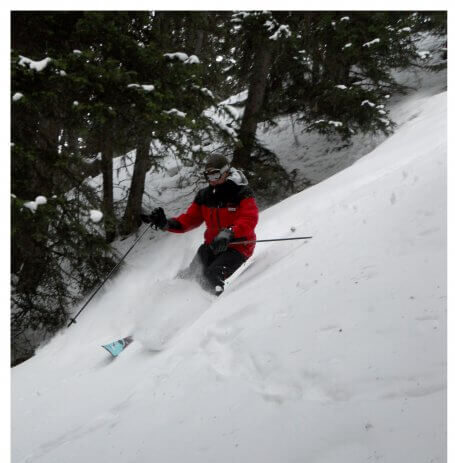
In this article, we look at the importance and benefits for everyone in doing these exercises and how an osteopath can help you with your skiing.
At Arc Osteopathy in Croydon and Carshalton, we are ideally placed to help you get the most from your trip and help you improve your ski technique as our Principal Osteopath Alan is also a qualified ski instructor and ski race coach. He knows the importance of being ready for your winter sports holiday and how a skier can benefit from Osteopathy treatment. We often think about our clothing, equipment, and resort, spending hours researching our options. Yet for many being fit for our ski holiday is left late and, in some cases, not at all.
We can carry out a Ski postural and movement assessment. During this we can detect any restrictions in movement, muscle imbalances or postural issues which will be present when you ski and can negatively affect your technique. We will explain our findings and produce a program to help correct any issues that we have found, which can include hands on treatment and more specific exercises tailored to help you.
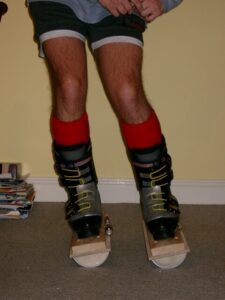
Being physically prepared matters. Lack of fitness and mobility increases your risk of injury to yourself, or worse still, leading to another person being injured. Your enjoyment can also be affected as you fatigue sooner, having to cut the day short, change the runs you ski and struggle to perform anywhere near your peak.
Starting these exercises sooner and on a regular basis has other health benefits too, making them great for almost everyone (if safe to do so), as well as preparing you for your ski holiday.
As well as the basics for most sports which include flexibility, strength, stamina and balance; skiing requires key skills of pressure, rotation, edge control and body separation/angulation.
So here are our 4 key exercises that will help you achieve your goals and that will help prepare your body for an improved quality life and improved skiing technique.
Safety Note: only try these exercises if you are injury free and it is safe for you to do them. Seek medical advice if you get pain other than muscle ache in the target area, or any other unexpected sign or symptom.
1.) Proprioception (Standing on 1 leg).
Why balance matters for everyone.
As we age, our ability to balance decreases and at 70 years old, falls off a cliff edge. Our inability to balance is a key indicator of our likelihood to fall more in daily life and can be a factor in affecting mortality.
For the average person, your balance peaks between the ages of 13 to 39 years at around 2 mins, then slowly reduces. At 60 years old it is 1 minute, 70years 40 seconds and at 80 years old only 10 seconds.
Why Balance matters for Skiers
From a skiing perspective good balance and adjusting your balance (balancing) will prevent falls, allowing you to absorb bumps, manage rutted terrain, a sudden change in snow conditions on a run, as well as improving your technique. You will have better control initiating and during the turn radius, and be able to cope better on different surfaces, from powder, a groomed piste or ice.
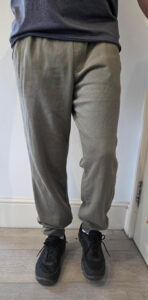
How to do a single leg stand.
If you have balance issues or a medical condition that affects your balance, then it is important that you speak to your GP or a regulated healthcare professional like an Osteopath or physiotherapist before commencing them.
If you are new to this, then gently hold on to a firm surface, like a strong table or kitchen worktop. As you improve and you feel safe, then touch a wall.
Keeping your body (from foot to head) vertical, lift one foot off the ground and leave near the ankle of the standing leg. Aim to hold for as long as possible. It is normal for the standing leg, knee or ankle to wobble a bit as you get used to the exercise. If you feel you are about to fall or start to lose balance, then you can quickly put your lifted foot down.
For those of you with no balance issues, stand away from the walls with your arms out to the side at shoulder height and then lift your foot. If this is easy, you can bring your arms across your chest so that you are holding the opposite shoulder.
How Osteopathy can aid balance.
For those who have good balance and want to be better still, our Osteopaths at ARC Osteopathy can provide further progressions suitable for the best skiers and assess to see if there are any muscle imbalances, postural concerns or biomechanical blockages to optimum efficient movement.
2.) Wall sits / wall squats.
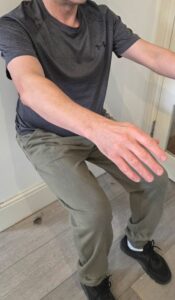
This is a great exercise, and as the name suggests, only requires a wall. It isometrically strengthens the quadriceps (front of the thighs), whilst also engaging the hamstrings (back of thighs), gluteal muscles (buttocks) and the core muscles.
Why Wall Squats are important for everyone.
This is not the only reason to do this. Along with the plank, researchers from Canterbury Christ Church University and Leicester University analysed 270 clinical trials which were published between 1990 to 2023 involving almost 16,000 people. While they found that all types of regular exercise lowered blood pressure, isometric strengthening exercises produced a larger decrease in resting blood pressure.
Regular exercises and a decrease in blood pressure can lower the risk of heart and circulatory diseases by up to 35%, according to the British Heart Foundation.
Why wall squats are great for skiers.
For skiers being able to move into and out of a squat position through the whole turn, helps with stronger turns, keeping the ski in contact with the snow, better edge control and less uncontrolled movement of the upper body. This makes your skiing safer, more enjoyable and you will fatigue less at speed, on harder terrain or when a slope is busy and you need to turn more. If you are adopting a more streamlined racing position, your quadricep muscles can really get punished and will feel the burn. Preparation is key.
How to do a wall squat.
Squat with your back against a flat wall, so that your hips and knees are bent to 90 degrees. Your feet and knees should be shoulder width apart. Your target is 2 minutes, but of course you can build up to this. Do ensure that your feet do NOT slip, so best done with shoes or trainers on.
If this sounds too much, you can hold onto a bar, or a solid table while you hold a half squat (45 degrees at the hip and knees) to start with.
How Osteopathy can aid thigh strength.
Again, our Osteopaths in Croydon and Carshalton, can provide progressions on this exercise and will also ensure that there is optimum movement in the lower back, hips, knees and ankles to maintain and move through this position when skiing.
3.) Hip rotation.
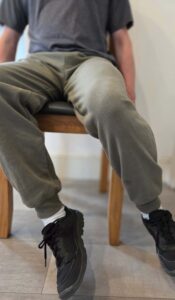
The hip is a very stable and strong ball and socket joint allowing multiple plans of movement.
Why Hip Rotation is important for everyone.
As our joints age we can start to lose the range of movement available at the hip joint and our amazing human body will start to compensate for this. This can put further responsibility for general movement and stability onto other joints. This often increases load and movement onto our knees, ankles and lower back, which can lead to issues with these joints. If there are already problems, with the lower back, knees or ankles, then they can be made worse, or the body will not compensate, putting more load on parts of the hip. All of which can affect walking and other movement patterns.
Why Hip Rotation is Important for skiers.
For skiing, rotation at the hip is essential to initiate a range of turns and is required during other turn shapes or piste conditions. It also helps ensure we keep more equal pressure on both the uphill and downhill ski. At a beginner to intermediate level, it is important in getting the uphill ski to start the turn and more advanced skiers will use hip rotation in short swing turns especially on steep terrain and during a mogul run.
One way to check if the hips are rotating equally is to sit on a strong table, with your knees just over the edge and the thighs at hip width apart. Then move both feet in one direction and then the other. Is the movement the same?
One way to improve hip rotation.
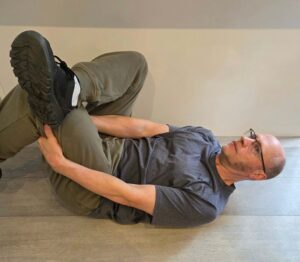
One exercise to help is a stretch which is sometimes termed a reverse pigeon pose. Lie on your back with knees and hips bent at 45 degrees at hip width apart and feet flat on the floor. Bring the right ankle across the front of the left thigh just above the knee. Then take hold of the back of the lower Left thigh with both hands and pull gently towards your chest until you feel a stretch in the right buttock muscles. Hold for at least 20 seconds (pain free). Return to the starting position and repeat on the other side.
How Osteopathy can aid Hip Rotation and Mobility.
Our osteopaths can help improve hip mobility in most people with assisted stretches, joint articulation, soft tissue massage and joint traction techniques. In cases where we cannot help or suspect an underlying cause, we will refer or recommend you for investigations or treatment elsewhere.
4.) Side bending of the torso.
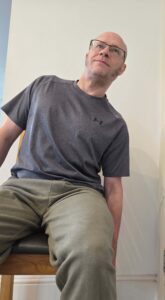
Why Side Bending is important for everyone.
We focus a lot on bending forward and backwards as well as turning around yet, bending to the side can be overlooked as a key movement.
However, when we think of a lot of daily tasks, for example getting in or out of car, picking up and carrying a bag, even getting out of bed, they all involve an element of side bending.
Why side bending is important in skiing.
In skiing, as you improve, side bending is key. It creates separation of the trunk from the lower body, allowing different angulation of the lower limb to the torso. This helps with edge control and pressuring the ski, which in turn can provide more power, speed control, and rebound in the turn, while also reducing slipping during the turn on icier terrain.
A simple exercise for Side bending and how to do it.
A simple exercise is to sit on a firm chair, with an upright back, then lean to one side while keeping both sides of the bottom in contact with the chair. Return to upright and repeat on the opposite side. If your movement is equal, you can add a light weight in each hand. For those skiers, who can side bend equally, you can do a standing version, pushing the hips one way, while side bending the opposite way.
How Osteopathy can aid Torso Mobility.
Our Carshalton and Croydon Osteopaths can assess whether you have reduced side bending. By analysing low back and hip movement, core stability and muscle tension in the back, hips and legs we can locate issues that prevent a good and functional range of movement. We can help correct any dysfunctional areas with a range of tailored osteopathic techniques as well as prescribing exercises to increase ranges of movement and improve stability.
Osteopathy and Ski Exercises for winter sports enthusiasts, part of your perfect ski holiday preparation.
At Arc Osteopathy our osteopaths are well placed to help you with your skiing to provide you with home-based exercises and tips to improve your technique and skiing experience. It is all based on a thorough assessment which includes posture, joint ranges of movement, ski movement assessment. Our principal Osteopath can also evaluate your skiing from your own videos to provide technical feedback.
At Arc Osteopathy in Croydon and Carshalton, we allow plenty of time, to undertake this detailed assessment in an unrushed manner, so that not only will you leave with exercises, but also understand the importance of them as part of any rehabilitation or preparation for your future ski trips.
Osteopathy and Ski exercises can be excellent for everyone.
As you have read, many exercises, ideal for a specific sporting demographic, like the ones above for skiers, are also great for most members of the public and can often have other health benefits. At Arc Osteopathy we are trained to assess your range and quality of movement, and to provide treatment for a range of muscle and joint pains, so that you can enjoy your ski trip and live life to the max.